
What about…?
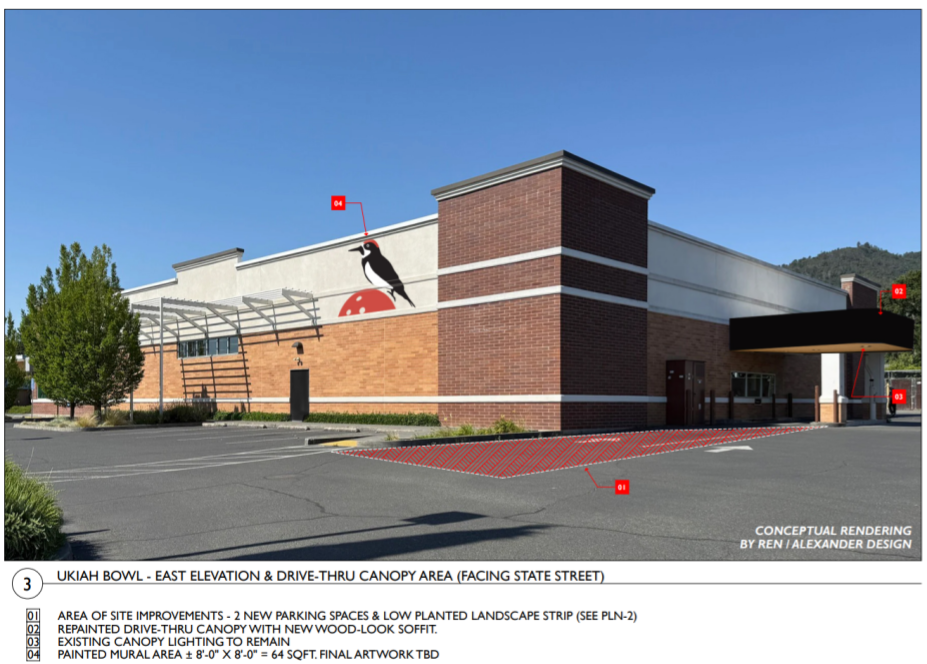
Being a good neighbor is important. Here’s a summary of considerations that went into plans for the site, operations, and build-out so far.
Parking
The proposal exceeds requirements for commercial recreation and public assembly. Today’s 59 vehicle spaces would increase to 65, on currently paved areas. Today’s 6 bike spots would increase to 18, encouraging alternative transportation.
Traffic
Ukiah Bowl would not open until 11am Thursday-Sunday, and not until 3pm Monday-Wednesday. So, almost no traffic for much of the morning and workday. Peak hours for Ukiah Bowl are typically closed or off-peak hours for surrounding businesses.
Compare that to a hypothetical popular grocery chain moving in, which would be open 30%+ more hours, with peak traffic the same as nearby stores.
Noise
Shorter and earlier-closing hours than most bowling alleys, no hard liquor license, the existing structure’s thick walls and minimal windows facing neighbors, and planned interior sound absorption are all factors that reduce or eliminate noise impacts.
We’ll continue looking and listening for any ways to improve, throughout planning and after opening (if approved!).
Proximity to schools
The two nearest schools are about 750ft and 1,000ft away. Ukiah Bowl would not be open during instruction hours Monday-Wednesday. The Thursday & Friday daytime crowd for bowling tends to skew toward seniors, and not very busy.
Proximity to senior housing
The considerations above are with all neighbors in mind, but especially the adjacent aged-55+ apartments. For one, we look forward to welcoming any existing or first-time bowlers!
In addition to the formal public process and comments online, we’re planning in-person times May 27 (midday) and May 31 (evening) at the former Rite Aid to talk with neighbors who’d like to discuss specifics on site. Times will be confirmed and shared closer to those dates.
Why not the former Big Lots, or empty land?
Two big priorities for this project were to a) own the building for feasibility and longevity, and b) reuse an existing vacant building in town if possible.
No other buildings were the right size, shape, column layout, and up for sale. Being central means local visitors have an easier time without a car, can pick up friends on the way, or at least drive fewer total miles. That’s time and money saved, and traffic offset.
---
Please keep any questions and comments coming, that’s what this phase is for.
